
Payette County Court Records After Arrest
A Payette County arrest can create several records at once. The jail records the booking and custody basis. The sheriff's Records Division packages arrest information for prosecutors. The Payette County Prosecuting Attorney then handles most criminal charges in District Court and misdemeanors outside city limits, while the Payette County Clerk processes and maintains court case filings. Once the case is filed, the court record is searched through Idaho iCourt or requested through the clerk.
That means a booking charge and a court charge are related, but they are not the same record. A booking entry may reflect the arresting agency's basis for jail intake. Court records after a jail arrest show the charge or charges the prosecutor files, later amendments, hearing dates, bond orders, warrants, dispositions, and case status. For current custody or booking detail, use Payette County jail inmate records. For booking photos, use the Payette County jail mugshots page.
Search Court Records After Arrest
The main public search tool is Idaho iCourt / Odyssey. Idaho iCourt materials state that electronic court records are available for all 44 counties and that Payette County was included in the portal's 2018 Wave 2. Public records can include party indexes, new filing lists, chronological case summaries, calendars or dockets, hearing dates, locations, case numbers, captions, and pending or closed case status when those items exist in electronic form.
- Confirm custody or recent booking through Payette County Jail/Inmate Records at (208) 642-6006 ext. 1143 if the arrest was recent.
- Search iCourt by defendant name. Try middle names or initials if common-name results appear.
- Search by case number when available from jail, clerk, prosecutor, citation, or court paperwork.
- Open the case summary and read the charge list, hearing dates, chronological events, and case status.
- Contact the Payette County Clerk if the case is missing, older, sealed, confidential, or unclear in the portal.
The iCourt public record search FAQ says the courts make every effort to update the website at least hourly during the working day to reflect trial-court changes. It also notes that some information is not provided to the public, including social security numbers, addresses, phone numbers, driver's license numbers, and financial account numbers.
Payette County iCourt Lookup
The Idaho Odyssey public portal is the public entry point for Payette County court records after an arrest when the case has been filed electronically.
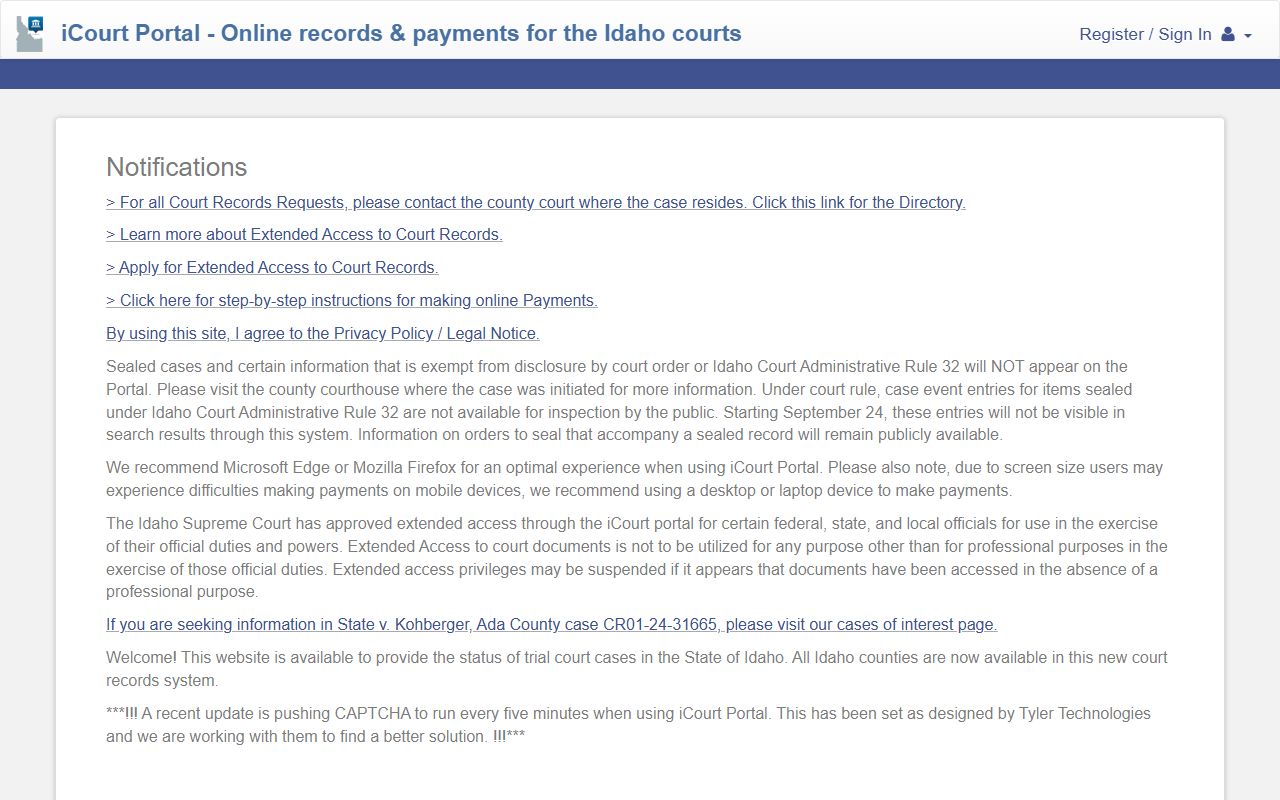
If a person was arrested but no court record appears yet, the case may not have been filed, may be under a different spelling, may involve a city prosecutor, or may be restricted under court-access rules.
Payette County Court Search Fields
Search fields can change as the portal is updated, but the research identified the practical search paths below. Use the narrowest identifier first. A case number is usually cleaner than a name search, but families often begin with a name because the case number is not known right after booking.
| Field Label | Type | Required | Notes |
|---|---|---|---|
| Smart Search | Text | Unspecified | Search by party name, case number, citation number, or related terms depending on the screen. |
| Party Search | Name fields | Unspecified | Useful when only the defendant name is known. |
| Case Search | Text or filter | Unspecified | Use the court case number when available. |
| County or location | Filter | Optional when visible | Narrow to Payette County or Idaho courts if the portal offers the filter. |
| Case type, status, date | Filters | Optional when visible | May help separate criminal cases from unrelated civil or traffic results. |
Payette County Charging Records
Court records after a jail arrest usually become clear when a charging document appears. The prosecutor's office is led by Mike Duke and has jurisdiction over criminal cases in District Court, misdemeanors outside city limits, and misdemeanors cited by Idaho State Police or Idaho Fish and Game. Fruitland city misdemeanors are an exception and are handled through the Fruitland City Prosecutor, so the arresting agency and location can affect where a record question belongs. The alternate county prosecutor page also points public users to iCourt for case information.
| Document | Who Files It | What It Does |
|---|---|---|
| Complaint | Often officer or prosecutor | Starts some criminal cases and states the alleged offense. |
| Information | Prosecutor | Formal charge document commonly used in felony practice. |
| Indictment | Grand jury | Formal charge returned by a grand jury. |
Complaint, information, and indictment are not verdicts. They are charging records. The final outcome depends on later court action, which can include amended charges, dismissal, plea, trial verdict, sentencing, probation, or post-judgment relief.
Charge Status After Arrest
Charge status is one reason court records after a Payette County arrest are more useful than a booking note. A jail booking may start with one description, but the prosecutor can amend, reduce, add, or dismiss charges as the case moves. The court case summary is the better place to check whether a charge is pending, resolved, or changed.
| Status | What It Means |
|---|---|
| Pending | The charge remains open and has not reached final disposition. |
| Amended | The prosecutor or court record changed the charge, wording, level, or count. |
| Reduced | The charge level or alleged offense was lowered from an earlier version. |
| Dismissed | The charge was ended by court action and is not a conviction. |
| Disposition | The recorded court outcome or action for the charge or case. |
Bond Records After Arrest
Payette County's detention page explains cash bond, surety bond, personal recognizance bond, book-and-release, and sentence completion. A cash bond can be paid by money order. A surety bond involves a professional bondsman, and the county notes that bondsmen generally charge a fee and may require collateral. A PR bond lets a defendant sign a promise to appear if approved through the courts or bond commissioners.
| Bond Type | How It Works in Payette County Sources |
|---|---|
| Cash bond | A cash amount is paid to cover the bond; the county mentions money order payment. |
| Surety bond | A registered bondsman posts the bond; checks are not accepted for surety bonds. |
| PR bond | The defendant promises to appear and must be approved through the court or bond commissioners. |
| Book and release | The arresting deputy may release a person after booking, usually for misdemeanors and sometimes for felonies. |
| No-bond or hold issue | Another warrant, detainer, agency hold, or court order can prevent release despite local bond. |
For a recent Payette County jail arrest, confirm custody and bond through Jail/Inmate Records before relying on a court docket alone. Bond orders and release conditions can change at first appearance, and the operations analysis notes that releases often rise after weekday arraignment hearings.
Charges vs Convictions
An arrest and a charge are not a conviction. Court records after a jail arrest can show allegations, motions, hearings, amended counts, and later outcomes. A conviction occurs only after a guilty plea, verdict, or other court action that creates a judgment. Treating a filed charge as guilt is inaccurate.
| Point | Charge | Conviction |
|---|---|---|
| Stage | Allegation filed in court | Final guilt finding or plea-based judgment |
| Can change | Can be amended, reduced, added, or dismissed | Changes only through later court relief or appeal |
| Public meaning | Shows what was alleged | Shows a court outcome |
Sealed and Expunged Records
Idaho Court Administrative Rule 32 governs public access and exemptions for Idaho court records. It is the key court-record rule when a Payette County file is sealed, confidential, restricted, or missing from the public portal. Idaho Code 19-2604 also provides certain set-aside or dismissal remedies after eligible probation or court compliance. Those remedies are case-specific and are not automatic mugshot or internet removal tools.
| Point | Sealed | Expunged or Set Aside |
|---|---|---|
| Public view | Hidden or limited under a court rule or order. | Relief depends on the statute and order entered. |
| Agency access | Some official access may remain. | Some official records may still exist as allowed by law. |
| How to check | Contact the Payette County Clerk if the public portal is unclear. | Review the court order and the exact Idaho statute used. |
Note: Missing iCourt information does not always mean no case exists; the record may be older, restricted, sealed, confidential, or filed under a different spelling.
Payette County Court Offices
Several offices can touch court records after a jail arrest. The Payette County Clerk, Lindsey Bratcher, provides clerical support for courts and processes court case filings at 1130 3rd Ave. N., Payette, ID 83661. The clerk's phone is (208) 642-6000, and the listed hours are weekdays from 9 AM to 5 PM, excluding holidays.
The Payette County Prosecuting Attorney is at 1115 1st Ave N., Payette, ID 83661. The phone number is (208) 642-6096, and official hours are 9 AM to 12 PM and 1 PM to 5 PM. The prosecutor's page says the office is open to the public by appointment only. Victim witness coordinator contact also routes through the prosecutor's phone number.
Payette County Clerk
1130 3rd Ave. N.
Payette, ID 83661
(208) 642-6000
Weekdays, 9 AM to 5 PM
Payette County Prosecuting Attorney
1115 1st Ave N.
Payette, ID 83661
(208) 642-6096
9 AM to 12 PM and 1 PM to 5 PM
Restricted Court Records After Arrest
Public court access has limits. ICAR 32 restricts categories of judicial records, and iCourt public materials state that personal identifiers such as social security numbers, addresses, phone numbers, driver's license numbers, and financial account numbers are not provided to the public. Juvenile, sealed, confidential, victim-sensitive, and other restricted case material may not be visible in ordinary searches.
Law-enforcement records are also separate from court records. Idaho Code 74-124 allows investigatory records to be withheld for enforcement, fair-trial, privacy, confidential-source, technique, or safety reasons. Basic arrest facts may still be treated differently from investigative narrative. If the court record is public but the police report is withheld, that difference usually comes from separate court and law-enforcement access rules.